Country context
Kazakhstan Demographics
Population, urban centres and cultural diversity explained carefully.
The bigger picture
Country context for travellers who want to understand more than a city checklist.
2,724,910
Land area (km²)
20.8M
Population
Astana
Capital city
Tenge
Currency (KZT)
Browse the section
Country context
Population, urban centres and cultural diversity explained carefully.
Quick Reference
Kazakhstan is the largest landlocked country in the world and the ninth-largest country by total land area. Formally known as the Republic of Kazakhstan, it sits at the meeting point of Europe and Asia, bordering Russia, China, Kyrgyzstan, Uzbekistan, and Turkmenistan.
| Category | Detail |
|---|---|
| Official name | Republic of Kazakhstan |
| Capital | Astana |
| Largest city | Almaty |
| Population | 20.5 to 20.8 million (2025–2026 estimate) |
| Area | 2,724,910 km² (9th largest in the world) |
| Official languages | Kazakh and Russian |
| Currency | Tenge (KZT) |
| Government | Unitary semi-presidential republic |
| Time zone | UTC+5 |
| Independence | December 16, 1991 |
These core facts about Kazakhstan set the context for the sections below, which go deeper into location, geography, population, and history.
Geographic Position
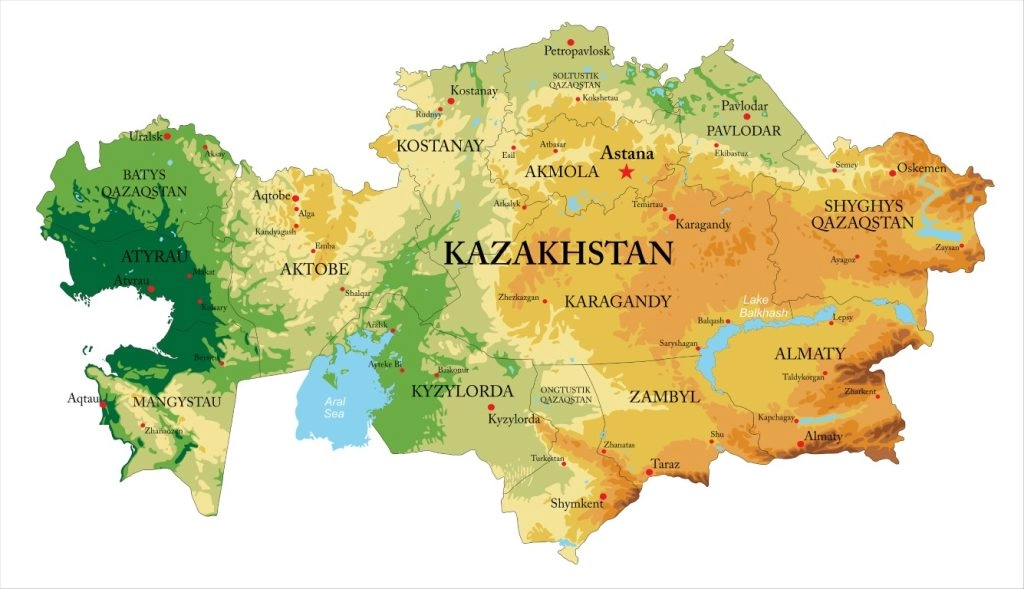
Kazakhstan sits in the heart of Central Asia, with a small portion of its territory west of the Ural River in Eastern Europe. That makes it one of only two countries in the world, alongside Azerbaijan, with land on two continents.
On a map, the distance from the Caspian Sea to the Altai Mountains spans roughly the width of Western Europe, covering six time-zone-equivalent widths of terrain.
Landscape & Climate
Kazakhstan geography is defined by immense scale and dramatic contrast rather than a single dominant landscape:
Urban Centres
The capital since 1997, world-renowned for futuristic architecture by Norman Foster and a severe continental winter climate.
The largest metropolis and financial center, nestled below the Trans-Ili Alatau mountains with vibrant cafes, culture, and nature access.
The third-largest city, a bustling southern hub granted special republican status in 2018 with rich Silk Road heritage.
Major industrial and commercial center situated in the country’s northwest near the European border region.
Historic industrial and mining heartland located in the expansive Kazakh Steppe of central Kazakhstan.
Demographics & Growth
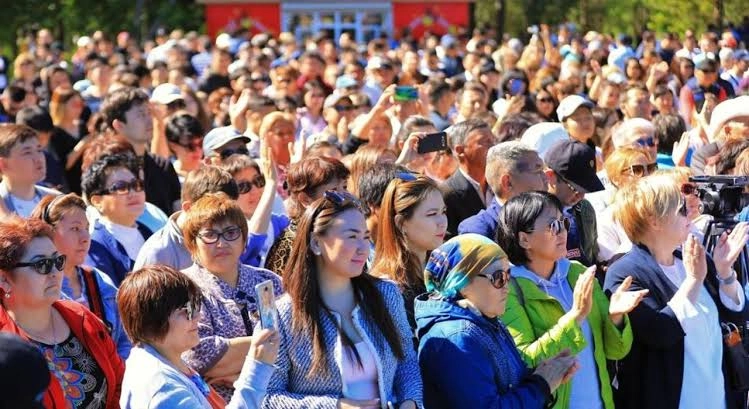
The population of Kazakhstan reached an estimated 20.8 million people in 2026, having officially crossed the 20-million mark in September 2024. The country is remarkably young: 29% of residents are under 15 years old, and only 9% are 65 or older.
Economic & Resource Profile
Energy & Minerals
World’s #2 in uranium, chromium, and zinc. Holds 11th-largest global reserves of petroleum and natural gas.
60% Central Asia GDP
Generates nearly two-thirds of Central Asia’s total economic output, trading with over 120 countries worldwide.
Wildlife & Parks
Maintains 10 national parks protecting snow leopards, Eurasian lynx, argali sheep, and reintroduced Przewalski’s horses.
Historical Timeline
Global Standing
#1
Highest HDI in Central Asia
99.5%
Adult Literacy Rate
#41
Economic Freedom Index
9th
Largest Country by Area
FAQ
Kazakhstan is located in Central Asia, bordering Russia to the north, China to the east, Kyrgyzstan, Uzbekistan, and Turkmenistan to the south, with a coastline on the Caspian Sea to the west.
Kazakhstan’s population is estimated between 20.5 and 20.8 million people as of 2025 and 2026.
Astana is the capital of Kazakhstan. Almaty, the largest city and cultural hub, served as the capital until 1997.
Kazakhstan is known for being the world’s largest landlocked country, its energy and mineral wealth, the Baikonur Cosmodrome spaceport, the Kazakh Steppe, Charyn Canyon, and rich nomadic traditions.
Kazakhstan is located primarily in Central Asia, with a small portion of its territory west of the Ural River situated in Eastern Europe.
Kazakh is the official state language, and Russian holds equal official status, widely used in business, administration, and daily life.
Yes, Kazakhstan is generally considered safe for international travelers, with major cities like Almaty and Astana offering modern infrastructure, low violent crime rates, and welcoming hospitality.
Explore Almaty